Description 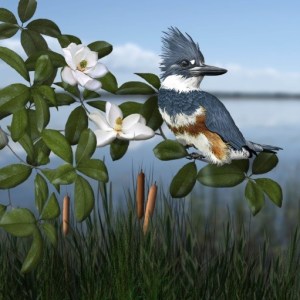
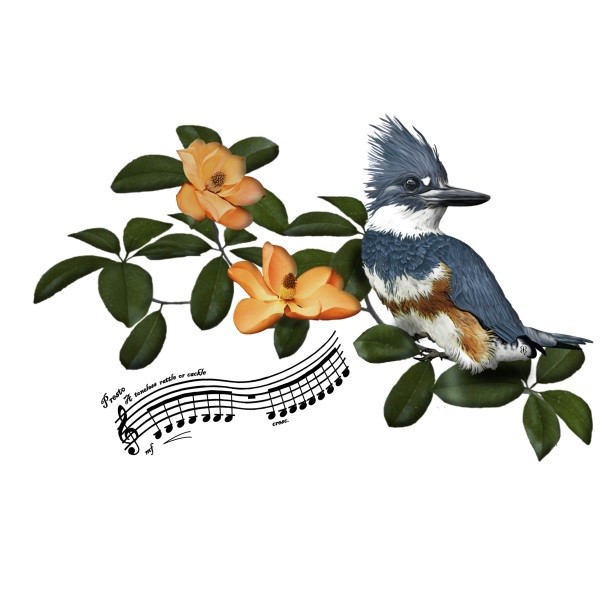
The approximately 12-inch long body of the adult Belted Kingfisher, Megaceryle alcyon, is generally blue-gray with a clearly defined white collar and blue-gray chest below the collar. The lower male breast is dull white, but the female sports a rust colored band extending down and back on either side of the lower breast. The head feathers of both rise in a striking ragged crest. The bill is straight, black, and sharp; and the birds have a white spot above the bill in front of each eye.
Habitat and Habits
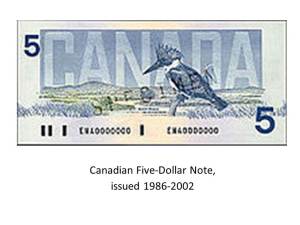 Because the Belted Kingfisher requires access to bodies of water for feeding, they are more often found near streams, lakes, estuaries, and bays throughout the North America. If the water does not freeze over winter, migration is reduced.
To create a nesting spot, males and females both burrow into the soft earthen banks on the shore. The earthen channels they burrow extend horizontally and slightly upward two to eight feet into the bank. The nesting chamber at the end of the tube is not lined but may be somewhat insulated with undigested bones, carapaces, and fish sales regurgitated by adults who have lost the juvenile ability to break down these materials in their diet. Swallows have been known to dig small side chambers in the burrows and reside with the kingfishers.
The birds also are known to employ dirt mounds created at construction sites for these burrows. Because of this capability to employ human structures and their tolerance of environmental contaminants due to aquatic prey that tends not to bio-accumulate toxins, this species falls into a reduced risk category of endangerment.
Belted Kingfishers do require clear, unimpeded water, however, in order to see their underwater prey. They perch over the water and stare into the depth until a suitable meal is spotted. Where upon it dives into the water – eyes closed – and grabs the animal with its bill, returns to pound the prey against the perch, and finally consumes the hapless creature head first.
To thwart an intruder in its territory, a perched Belted Kingfisher will heave its body up and down with its crest elevated, or fly back and forth along the water, rattling noisily until the intruder leaves. If threatened, it may scream, spread its wings, and raise the patch of white feathers next to each eye (All About Birds), or even dive into the water (What Bird).
Sounds 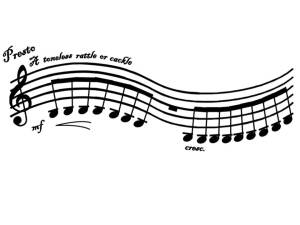
Rather than a song, the Belted Kingfisher emits a kek-kek-kek rattle when flying and that crescendos upon alighting a perch. The rattle almost seems a chuckle when vocalized after catching prey. The sound is so characteristic, that a group of kingfishers is called a rattle.
Sound links to the Belted Kingfisher:
http://www.audubon.org/field-guide/bird/belted-kingfisher (lower sidebar)
https://identify.whatbird.com/mwg/_/0/identify.whatbird.com/obj/61/overview/Belted_Kingfisher.aspx
http://www.vwrrc.vt.edu/virginia_water_radio/mp3_archive/vwr224Jul282014.mp3 (Virginia Water Radio episode: http://www.virginiawaterradio.org/2014/07/episode-224-7-28-14-belted-kingfisher.html)
http://www.xeno-canto.org/species/Megaceryle-alcyon (63 foreground recordings and 32 background recordings of Megaceryle alcyon)
https://www.youtube.com/watch?v=fTFxIF5FY-Q (Birds, Inc)
https://www.youtube.com/watch?v=pAB1Z80nlBU (Wild Call)
https://www.youtube.com/watch?v=XV_dIorqwSU (wklein 24)
Products
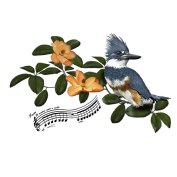
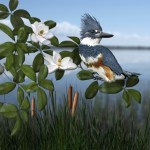 Visit the Avian Note Art collection at Watershed Wildlife Designs (watershedwildlifedesigns.com) to find these belted kingfisher designs on a wide variety of items, such as:
blankets, pillows, totes, shower curtains, shirts, hoodies, mugs, greeting cards, aprons, cutting boards, pot holders, phone and ipad covers. And more!
Gifts for birdwatchers, friends, and family!


 Avian Note Art
I love this!
LikeLiked by 1 person