Eastern Bluebird

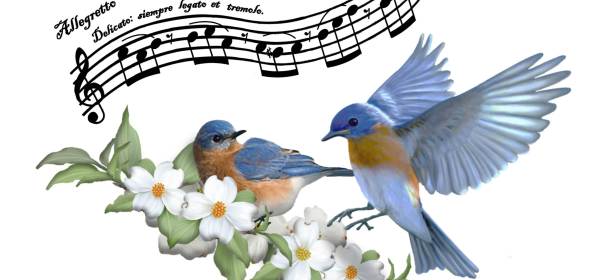
The Eastern Bluebird, Sialia sialis, is a small thrush (Family Turdidae) with a plump body, relatively short legs, and a short straight bill. The males are a brilliant cerulean blue on the back, head, and shoulders , while the  throat and breast are a rust color. The colors of the female are more subdued: grayish back with blue-gray wings and tail, and a muted burnt orange breast.  The perceived color, however, can be significantly affected by ambient light, especially to the bluebirds themselves. Unlike humans, bluebirds see in the ultraviolet range, and recent research suggests that males reflect strongly in the UV range.
Red Wing Blackbird

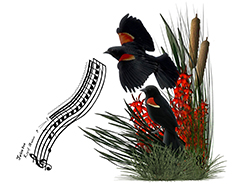
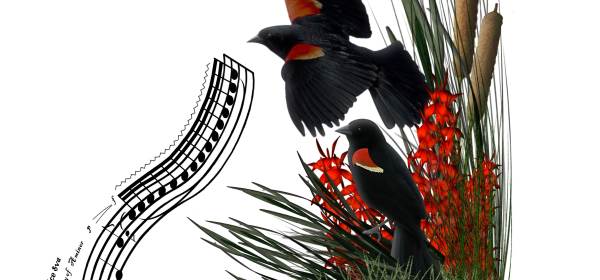
The red wing blackbird, Agelaius phoeniceus, sports distinctive red shoulder patches with a pale yellow wingbar below each epalulet.

Its distinctive characteristic coloring and its frequent association with healthy aquatic environments make this bird a welcome addition to any natural setting and a favorite of outdoor enthusiasts.
While calls are described as a single short “check”: chuck, chat, chit, chip, or chat, the red-wing blackbird song has been characterized similarly as: “konk la ree,” “conk la lee,” “conk a ree” (Thoreau) or “o ka lee” (Emerson), “Kong quer ree,” Gl oogl eee,” and “Gug lug geee.” Matthews (1904) notes that all descriptions agree on two points: three syllables and a repetition of the vowel e in the last syllable. Matthews represents the steady rhythm as Gug’ lug’ gee-e-e-e-e-e-e, with the e indicating a sustained tone. Although the written song is relatively plain (See below) with little accuracy of pitch (sometimes pardonably flat and sometime distressingly sharp!), Matthews describes the sound as “gurgling” like a brook: a welcome and joyous announcement that spring is at hand.

Belted Kingfisher

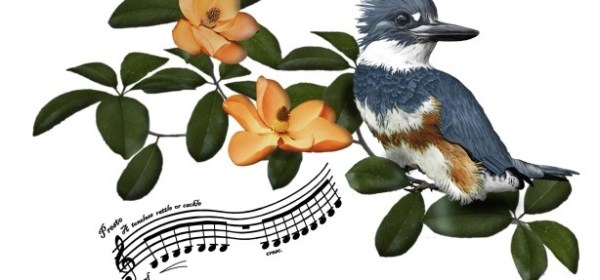
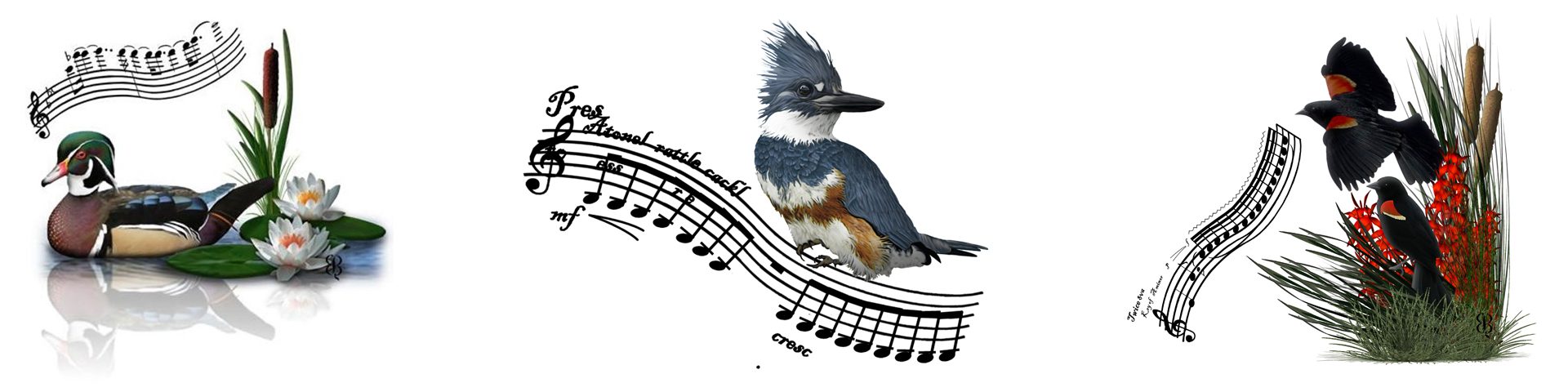
The approximately 12-inch long body of the adult Belted Kingfisher, Megaceryle alcyon, is generally blue-gray with a clearly defined white collar and blue-gray chest below the collar. The lower male breast is dull white, but the female sports a rust colored band extending down and back on either side of the lower breast. The head feathers of both rise in a striking ragged crest.

Wood Duck

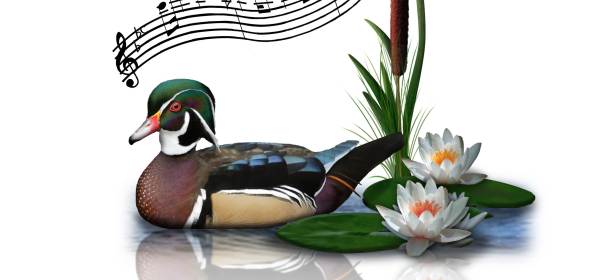
The wood duck, Aix sponsa, is one of the most distinctive and beautiful dabblers (i.e., ducks that don’t usually dive for food, but rather skim food from the surface or feed by tipping the head and neck forward. https://web.stanford.edu/group/stanfordbirds/text/essays/Dabblers_vs._Divers.html ). The helmet-shaped head of the male is iridescent green and outlined with white slashes. The eyes and upper beak are red. The helmet of the female is plain, but the eyes are outlined dramatically in white.

Woodcock

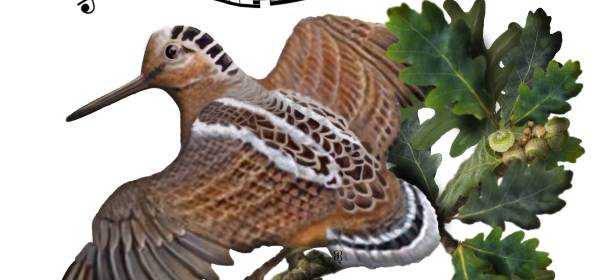
Related to sandpipers, the American Woodcock, Scolopax minor, or “timberdoodle,” is a shorebird that doesn’t live at the shore! Rather than live along bodies of water, this well-camouflaged, mottled, light brown bird inhabits deciduous forests where it spends most of its time feeding on the forest floor and nesting in depressions on the ground.

Northern Cardinal

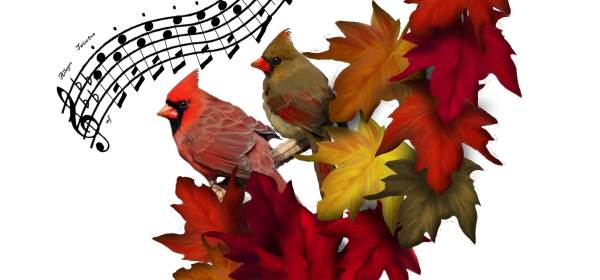
Cardinalis cardinalis, the Northern Cardinal, is the state bird for seven eastern states. The male colors are a bright scarlet, although the plumage of the upper body and crest is tinged with gray, and the bill is a dull red. The area between the bill and eyes and the throat are black.

1 2