

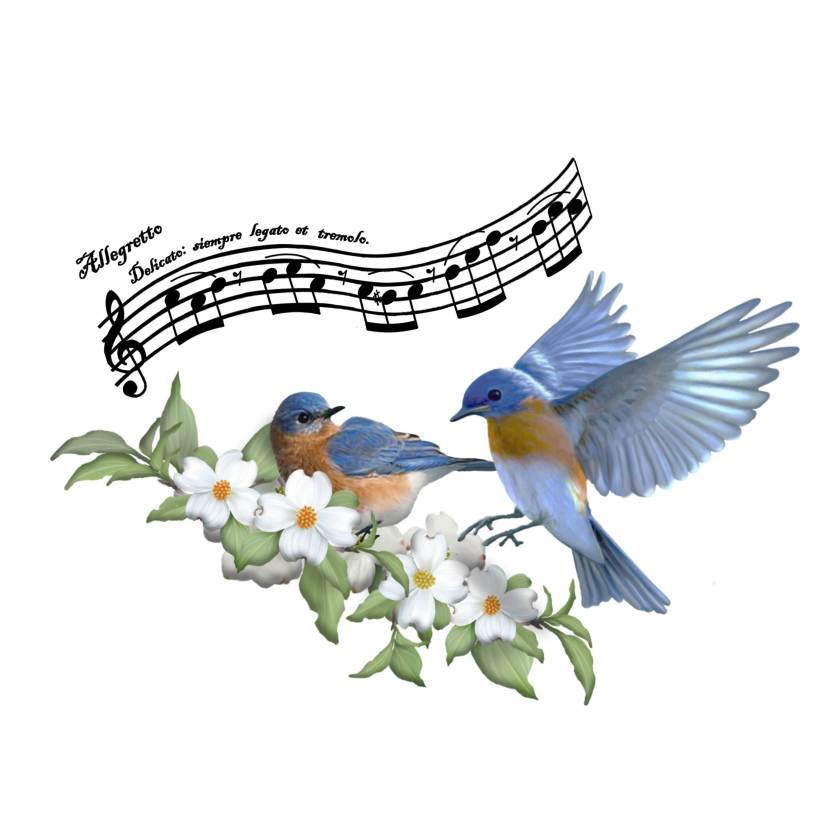
Description
 The Eastern Bluebird, Sialia sialis, is a small thrush (Family Turdidae) with a plump body, relatively short legs, and a short straight bill. The males are a brilliant cerulean blue on the back, head, and shoulders , while the throat and breast are a rust color. The colors of the female are more subdued: grayish back with blue-gray wings and tail, and a muted burnt orange breast. The perceived color, however, can be significantly affected by ambient light, especially to the bluebirds themselves. Unlike humans, bluebirds see in the ultraviolet range, and recent research suggests that males reflect strongly in the UV range. (https://birdsna.org/Species-Account/bna/species/easblu/introduction )
The colors of Western Bluebird, Sialia mexicana, are reverse those of the Eastern Bluebird. The male has a blue throat and rust shoulders instead.
Male mountain Bluebirds, Sialia currucoides, lack the rust coloring, with sky blue backs, darker wings, and lighter breast. The females are mostly a grayish brown with blue tinges on the wings.
Habitat and Habits
Bluebirds prefer open ground with short vegetation, occasional patches of trees, and a ready supply of insects. They do not make their own nest cavities, but the female builds her nest in available tree cavities, abandoned woodpecker holes, and human-made birdhouses. Tolerant of humans, bluebirds do not mind nesting near them.
Socially monogamous, bluebirds females are known to mate with more than one male, and as many as one quarter of the eggs in a brood involve a parent not of the nesting pair. Despite a reputation for amiability, bluebirds are quire aggressive. Especially the females are known to wound and even kill each other over access to nesting locations. Male aggression on females, however, is rare.
Although populations fell during the previous century due to competition with starlings, Eastern Bluebird numbers have been recovering as a result of nest box campaigns over the last 40 years. The Western Bluebird is more threatened than the other bluebird species, and the Mountain Bluebird less so because of its more remote habitat. (https://www.audubon.org/field-guide/bird/eastern-bluebird)
Sounds
Matthews (1904) compared the tones of the Eastern Bluebird to those of a Robin: The [bluebird] tones are unmistakable, quavering, tentative, uncertain, a bit tender and sentimental, and far more appealing than the robust ones of the Robin. The little singer does not seem to know how to rest steadily on any one tone! There is a pleading quality to his voice – a plaintive tenderness which is entirely due to the unsteady character of his notes. No robin sings this way, however similar the notations the two birds appear to the eye.”
Although Matthews found the songs of individual bluebirds consistent, current studies document much variability not only among species, but also among individuals. Research reported by Cornell (https://birdsna.org/Species-Account/bna/species/easblu/sounds) found “the repertoire of each male to be distinctive; two or more of the males shared only 6 of 309 song types, and these males used 64% of song types only during a single day’s observations.” The discrepancy might be explained by the findings of Kight and Swaddle (2015. Eastern Bluebirds Alter their Song in Response to Anthropogenic Changes in the Acoustic Environment. Integrative and Comparative Biology, Volume 55, Issue 3, 1 September 2015, Pages 418–431, https://doi.org/10.1093/icb/icv070) in their study on the effect of ambient noise on Eastern Bluebird songs. They found that individual songs change in response to noise changes in the environment, suggesting anthropogenic effects. (https://academic.oup.com/icb/article/55/3/418/757450) Matthew’s observations in rural areas before heavy industrialization may reflect the original condition, and this difference suggests additional potential investigation.
Furthermore, songs of the three bluebird species are distinctive. The Eastern Bluebird makes a note that sounds like tru-ly, and the song has soft gurgling notes. The Western Bluebird, however, sounds like pew, while Mountain Bluebirds have a chru sound and a song that is a low warble. (http://www.all-birds.com/Bluebird.htm)
Eastern Bluebirds generally sing a fairly low-pitched, warbling song made up of several phrases, each consisting of one to three short notes. Harsher chattering notes may be interspersed with the whistles. The whole song lasts about two seconds. More specifically, songs seem to be grouped as Loud or Soft. The Loud Song predominates during nest building and egg laying months; the Soft Song during incubation.
An excellent analysis of vocalization summarized at https://birdsna.org/Species-Account/bna/species/easblu/sound (See figure from the web page on the left) compares the two song types with corresponding sonagrams: The Loud Song is a rich warbling, low in pitch, delivered rapidly with short pauses between. Alliterative rendering sometimes is given as tury, cherwee, cheye-le , and ayo ala loee—alee ay lalo leeo. During singing bouts, males may pivot their body so that singing is sequentially in opposite directions. The male Soft or Whisper Song, on the other hand, is similar but obviously more quiet and may function to assure nesting females.
Sound links to Bluebirds:
Eastern
https://www.xeno-canto.org/species/Sialia-sialis (91 foreground recordings and 80 background recordings)
https://musicofnature.com/bluebird-talkings/ (Elliot Lang website)
https://birdsna.org/Species-Account/bna/species/easblu/multimedia/audio
https://birdsna.org/Species-Account/bna/species/easblu/sounds
https://www.bird-sounds.net/eastern-bluebird/
https://www.birdnote.org/show/voices-and-vocabularies-eastern-bluebirds
https://www.allaboutbirds.org/guide/Eastern_Bluebird/sounds
https://www.youtube.com/watch?v=e0CkR4O7JRM (American Bird Conservancy)
https://www.youtube.com/watch?v=WKitWY-ETvA (Front Yard Video)
https://www.youtube.com/watch?v=R8lPVq00DDM (Bluebirds in the Snow by Top10 Images.com )
Mountain
https://www.xeno-canto.org/species/Sialia-currucoides (27 foreground recordings and 21 background recordings)
https://www.allaboutbirds.org/guide/Mountain_Bluebird/sounds
https://www.bird-sounds.net/mountain-bluebird/
Western
https://www.xeno-canto.org/species/Sialia-mexicana (43 foreground recordings and 100 background recordings)
https://birdsna.org/Species-Account/bna/species/wesblu/introduction/ (with sonogram)
https://www.allaboutbirds.org/guide/Western_Bluebird/sounds
https://www.bird-sounds.net/western-bluebird/
Products

 Visit the Avian Note Art collection at Watershed Wildlife Designs (watershedwildlifedesigns.com) to find these Bluebird Skies designs on a wide variety of items, such as:
blankets, pillows, totes, shower curtains, shirts, hoodies, mugs, greeting cards, aprons, cutting boards, pot holders, phone and ipad covers. And more!
Gifts for birdwatchers, friends, and family!

 Avian Note Art