Description and Habitat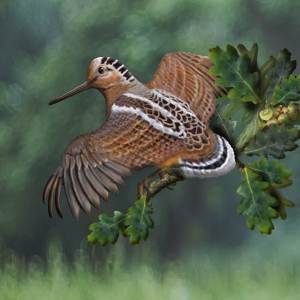
Related to sandpipers, the American Woodcock, Scolopax minor, or “timberdoodle,” is a shorebird that doesn’t live at the shore! Rather than live along bodies of water, this well-camouflaged, mottled, light brown bird inhabits deciduous forests where it spends most of its time feeding on the forest floor and nesting in depressions on the ground.
The most conspicuous physical feature of these inconspicuous birds is the placement of the eyes unusually far back on their skulls, allowing them to gaze skyward for predators while simultaneously probing the ground for earthworms and soil arthropods with its long bill. While searching, the woodcock sometimes performs an odd rocking motion that is thought to disturb bugs and earthworms, thus encouraging the critters to move and reveal their position to the woodcock that can sense the movement (http://www.audubon.org/field-guide/bird/american-woodcock ).
Known to live over 11 years, the American Woodcock is a common woodland resident, but the population is slowly declining due to habitat loss and toxin exposure, rather than hunting. Woodcocks forage on the forest floor, where they can bio-accumulate pesticides from aerial spraying against forest pests that the birds later consume. A heavy diet of earthworms makes them vulnerable also to poisoning by heavy metals in the soil. . The woodcock is, therefore, on the 2014 State of the Birds Watch List, as a species in danger but currently not yet requiring significant conservation action.
Habits
The Friends of the 500th, a nonprofit corporation that supports the Canaan Valley National Wildlife Refuge in West Virginia (http://friendsofthe500th.org/ ), promotes the American Woodcock as a “trust resource” through local activities and their monthly publication, The Timberdoodle. Their focus on the woodcock is based on their recognition of its importance of as a species and their fondness for the male bird’s unique flying courtship behavior called the “sky dance,” during which the bird flies upward several hundred feet and then rapidly descends again, all the while emitting a complex series of whistling sounds. These sounds are not vocal, but produced by the wings!
Sounds
David Sibley (The Mysterious Sounds of the American Woodcock, http://www.sibleyguides.com/2015/04/the-mysterious-sounds-of-the-american-woodcock/) describes the properties of the sound and the mechanism for producing it:
Most of the flight display involves a steady twittering sound …continuous for twenty seconds or so as the bird climbs several hundred feet. As the display progresses, and especially during the final seconds as the bird descends rapidly, the woodcock produces a much more intricate and complex series of sounds, with loud clear chirps interspersed among the twittering. Displaying males give a repeated, buzzy, nasal peent while on the ground between flights.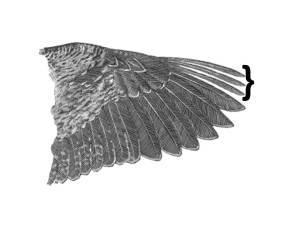
The graphic to the right shows spread wing of a male American Woodcock with the three modified outer narrow primary feathers that produce a whistling sound as air rushes through them in flight.
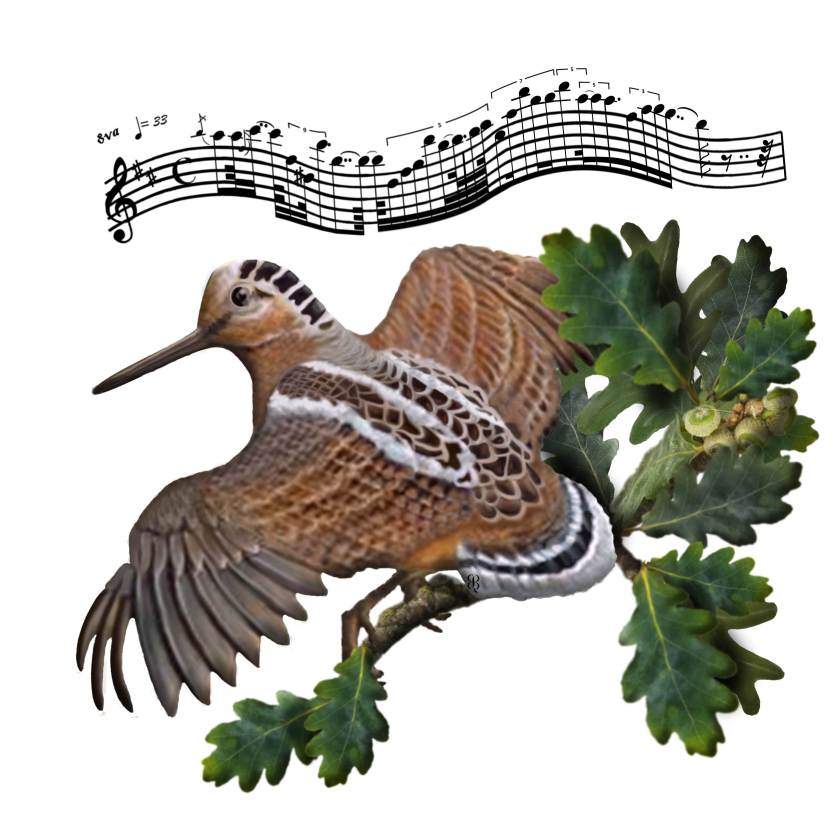
The graphic below shows the final five seconds of the display flight of American Woodcock, showing the complex arrangement of chirps (tall vertical slashes) and twitters (short high notes). All of the chirps are perfectly and regularly inserted between the twittering notes.

(http://www.sibleyguides.com/wp-content/uploads/American_Woodcock_final5sec.gif)
Supporting the idea that these are wing sounds (not vocal), Sibley cites a few circumstantial points:
- The pitch and quality of the chirps is similar to the normal wing twitter, just an enhanced version.
- There are no reports of chirps, or any vocalization resembling these chirps, being heard from a woodcock on the ground or in low flight; only during the flight display, and mainly in the steepest and fastest descent. The known vocalizations of American Woodcock are all lower: gruff, croaking, or buzzy.
- The chirps are interspersed among the twittering sounds in the display, but never overlapping any of those. If the chirps were vocal, they would overlap some of the twittering; instead they perfectly fill the gaps between tweets.
- Chirps are produced during the descent at the end of the display, and coincide with certain abrupt movements as the bird swoops back and forth, as would be expected for a wing noise.
Links to the sky dance and to woodcock vocalizations:
https://www.allaboutbirds.org/guide/American_Woodcock/
http://www.audubon.org/field-guide/bird/american-woodcock (sounds in sidebar)
http://birdnote.org/show/woodcocks-sky-dance
http://www.xeno-canto.org/species/Scolopax-rusticola (132 foreground recordings and 34 background recordings of Scolopax rusticola .)
http://www.xeno-canto.org/217766
https://www.youtube.com/watch?v=ta1fxy0MR2c (excellent video of dance with wing whistles and landing chirps, and then ground call “peent”)
https://www.youtube.com/watch?v=cKPLaUdTAfc
Products
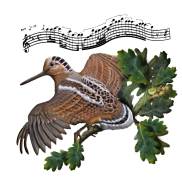 Visit the Avian N
 ote Art collection at Watershed Wildlife Designs (watershedwildlifedesigns.com) to find these woodcock designs on a wide variety of items, such as:
blankets, pillows, totes, shower curtains, shirts, hoodies, mugs, greeting cards, aprons, cutting boards, pot holders, phone and ipad covers. And more!
Gifts for birdwatchers, friends, and family!


 Avian Note Art
